

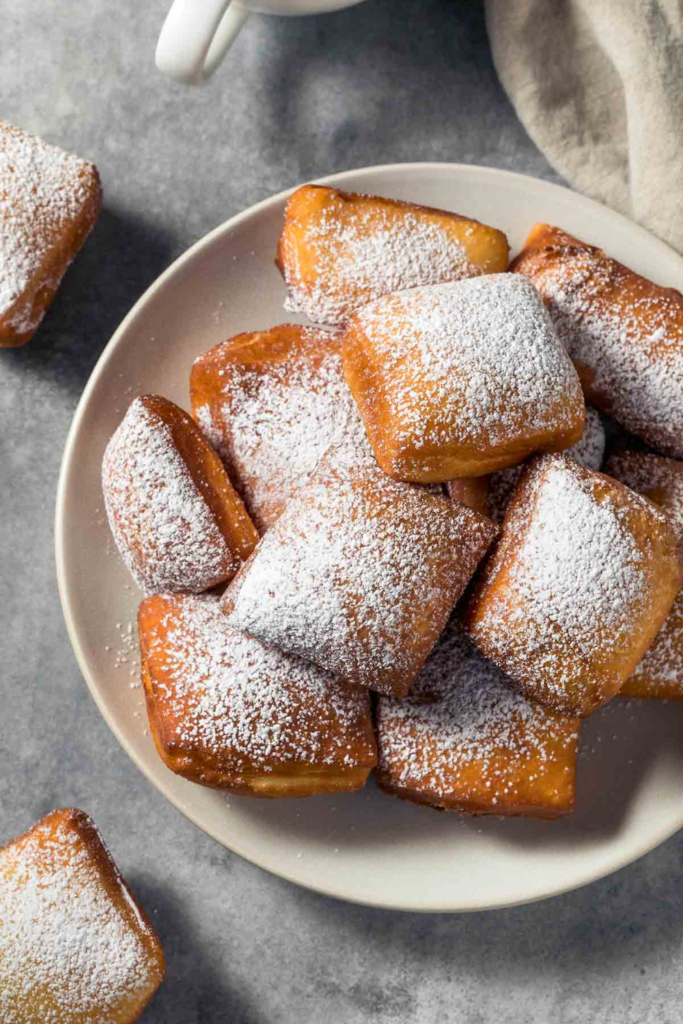

I didn’t grow up making beignets. The first time I tried one, it was messy, covered in powdered sugar, and completely unforgettable. I remember thinking, this is basically a donut’s softer, cooler cousin.
So of course I went home and tried to make them myself. And wow, my first batch was terrible. Flat. Greasy. I was convinced I had done something horribly wrong.
Turns out, beignets are actually very simple. But they do ask for a little patience and a little trust in the process. Once I stopped overthinking everything, they started turning out exactly how I wanted. Puffy, golden, and gone within minutes.
Now I make these whenever I want something that feels a little special but doesn’t require fancy ingredients. Just pantry staples and a willingness to get powdered sugar absolutely everywhere.
Ingredients I Used for the Recipe
- Warm water – This wakes up the yeast and gets the dough started. If the water feels like a warm bath, you’re good.
- Active dry yeast – The magic behind that light, airy texture. This is what makes them puff instead of staying dense.
- Granulated sugar – Adds a light sweetness and helps feed the yeast so it can do its thing.
- Eggs – These give the dough richness and structure without making it heavy.
- Whole milk – Makes the inside tender and soft. I’ve tried other milk, but this gives the best texture.
- Vanilla extract – Just a little for warmth and flavor. It doesn’t scream vanilla, it just rounds everything out.
- All-purpose flour – The base of the dough. Nothing fancy needed here.
- Melted butter – Adds flavor and keeps the dough from feeling dry.
- Vegetable oil for frying – A neutral oil works best so the flavor stays clean.
- Powdered sugar – The signature finish. And yes, you need more than you think.
- Optional toppings like chocolate sauce or fruit – Fun extras, but honestly I usually stick to powdered sugar.
How to make Starbucks Medicine Ball Recipe?
Step 1 – Wake Up the Yeast
I start by pouring warm water into a bowl, then stirring in the yeast and sugar. Then I leave it alone for a few minutes.
If it gets foamy, you’re on the right track. If nothing happens, the yeast is probably old. I’ve made that mistake more than once.
Step 2 – Add the Good Stuff
Next I whisk in the eggs, milk, and vanilla. At this point it smells slightly sweet and comforting, which is always a good sign.
This step is simple. No need to overmix or stress about it.
Step 3 – Build the Dough
I add part of the flour, then the melted butter, then the rest of the flour. The dough starts shaggy and awkward looking.
That’s exactly how it should look.
Step 4 – Knead Until Smooth
I turn the dough onto a floured surface and knead it with my hands. Nothing fancy, just folding and pressing.
After a few minutes it becomes soft and smooth. If it sticks too much, I sprinkle in a little flour. Just a little. Too much makes tough beignets.
Step 5 – Let It Rise
I place the dough into a lightly oiled bowl and cover it. Then I let it sit in a warm spot until it doubles in size.
This is the hardest part because it looks like nothing is happening. But inside, all that yeast is creating the airy texture we want.
Step 6 – Roll and Cut
Once risen, I roll the dough out to about a quarter inch thick. Then I cut it into squares. They don’t need to be perfect.
The odd-shaped ones always taste the same anyway.
Step 7 – Heat the Oil
I heat a few inches of oil in a heavy pot. Instead of obsessing over numbers, I test it by dropping in a tiny scrap of dough.
If it sizzles and floats up, it’s ready.
Step 8 – Fry in Batches
I fry a few pieces at a time so the oil doesn’t cool down. They puff up fast, which is honestly one of the most satisfying kitchen moments ever.
I flip them once they’re golden, not dark brown. They only take a minute or two per side.
Step 9 – Drain and Dust
I move them to a paper towel-lined plate, then immediately shower them with powdered sugar.
And I mean shower. A light sprinkle is not enough.
Tips
If your yeast doesn’t foam at the beginning, start over. I know it’s annoying, but it saves you from dense beignets later.
Don’t overcrowd the pot. I did that once trying to hurry things along, and they came out oily instead of airy.
If the dough feels sticky while kneading, add flour one tablespoon at a time. Dumping in too much at once changes the texture.
Scraps from cutting the dough are totally usable. I fry them exactly as they are. They’re usually the ones I snack on while cooking.
Beignets are best fresh. They really are. They lose that magic if they sit too long, though I’ve still eaten leftovers the next day without regret.
You can make the dough ahead and let it rest in the fridge overnight. I like doing this when I know I want an easy morning treat without starting from scratch.
Serving, Make Ahead, and Storage
I serve these hot. Always hot. That contrast between the warm dough and the snowy powdered sugar is the whole experience.
Sometimes I add chocolate sauce or fruit if I’m feeling fancy, but most of the time I don’t bother. The classic version is already perfect.
If I need to plan ahead, I make the dough the night before and refrigerate it. It rises slowly, which actually builds great flavor.
Leftovers can sit in an airtight container for a couple days, though they’re never quite the same. A quick warm-up helps a little.
I’ve even frozen them before. Not ideal, but still good when the craving hits and I don’t feel like frying a new batch.
What I’ve learned after making these again and again is that beignets aren’t about precision. They’re about feel. Soft dough. Hot oil. A ridiculous amount of powdered sugar.
And accepting that your kitchen will look like a sugar storm passed through. Totally worth it.
Beignets Recipe
Description
Making authentic New Orleans Style Beignets in your kitchen doesn’t get any easier or tastier than this recipe, made from scratch with pantry staple ingredients and easy-to-follow step-by-step instructions! Resulting in perfectly deep-fried, pillowy beignets just like the ones served at Cafe du Monde – the mountain of powdered sugar included!
ingredients
Instructions
-
Pour the warm water into a medium-sized bowl. Whisk in the yeast and granulated sugar and allow it to sit for 5–10 minutes until slightly foamy.If it doesn’t foam, your yeast may be expired or the water was too hot.
-
Whisk in the eggs, whole milk, and vanilla extract.
-
Add 2 cups of the flour, then the melted butter, followed by the remaining flour. Knead by hand on a floured surface until smooth. Add more flour (1 tbsp at a time) if too sticky.
-
Form the dough into a ball and place in a lightly oiled bowl. Cover with plastic wrap or a damp towel and let rise in a warm place for 1–2 hours, or until doubled in size.For make-ahead: refrigerate immediately after mixing and let proof overnight.
-
Roll out the dough to ¼-inch thickness on a floured surface. Cut into 2½-inch squares. Do not re-roll scraps—fry them as-is for extra treats.
-
Heat oil in a large heavy-bottomed pot to 370°F (190°C). Use a candy thermometer to monitor temperature.Alternative oils: peanut, soybean, sunflower, or corn oil.
-
Fry beignets in small batches (3–4 at a time) for 1–2 minutes per side, until golden brown. Spoon oil over the tops while frying.Overcrowding lowers oil temp and prevents puffing.
-
Drain on paper towels. Generously dust with powdered sugar while still warm.Serve immediately with café au lait for the full New Orleans experience!
Nutrition Facts
Servings 25
Serving Size 1 beignet
- Amount Per Serving
- Calories 210kcal
- % Daily Value *
- Total Fat 8gg13%
- Saturated Fat 2.5gg13%
- Trans Fat 0gg
- Cholesterol 18mgmg6%
- Sodium 65mgmg3%
- Potassium 50mgmg2%
- Total Carbohydrate 30gg10%
- Dietary Fiber 1gg4%
- Sugars 10gg
- Protein 4gg8%
- Calcium 20 mg
- Iron 1 mg
* Percent Daily Values are based on a 2,000 calorie diet. Your daily value may be higher or lower depending on your calorie needs.
Note
- Make ahead: Refrigerate dough after mixing; let it proof slowly overnight.
- Storage: Best served fresh, but can be kept in an airtight container for 2–3 days or frozen up to 2 months.
- Oil tip: For authentic Café du Monde flavor, use cottonseed oil if available.
- Variations: Top with cinnamon sugar, chocolate sauce, or fruit jam instead of powdered sugar.

Frequently Asked Questions
Can I use instant yeast instead of active dry yeast?
Yes! Use the same amount of instant yeast and mix it directly with the flour—no need to proof it in water first.
Can I bake or air fry these instead of deep frying?
Traditional beignets require deep frying for their signature airy texture. Air frying may work but will yield a different (denser) result. Not recommended for authenticity.
Why didn’t my beignets puff up?
Possible causes: expired yeast, water too hot/cold during activation, overcrowded fryer (lowers oil temp), or dough rolled too thin. Ensure oil is at 370°F and fry in small batches.